For many homeowners, the first sign of a serious problem isn't something they see, it’s something they hear. You take a step on your staircase or walk across the living room, and the floorboards groan, squeak, or feel uncomfortably "spongy" under your feet.
While it is easy to dismiss a squeaky floor as just a quirk of an aging house, these sounds can often be the "canary in the coal mine" for a much deeper issue hiding within your walls and subfloor. In many cases, what feels like simple settling could actually be the result of microscopic pests destroying the structural integrity of your home from the inside out.
Squeaky wood and sagging floors are often the result of advanced termite activity. However, because termites consume wood from the inside while leaving the surface intact, distinguishing between "normal" wear and tear and a termite infestation requires a keen eye for specific evidence.
Here is how to analyze your home’s symptoms to determine if you are dealing with a hidden termite colony.
Your floor is trying to communicate with you. The specific noises emanating from your walls and floorboards can provide critical clues about the health of the wood underneath.
If your floorboards or stairs have suddenly started to squeak, or if they feel "spongy" when you step on them, the wood may have been compromised. When a termite infestation becomes advanced, the pests consume enough of the internal cellulose to weaken the structural members.
Because termites burrow through wooden fixtures, flooring, and foundations, they often leave a thin outer shell of wood or paint while destroying the core.
Believe it or not, the termites themselves can be noisy neighbors. In situations of extreme quiet, you may be able to hear them inside your walls.
If the sounds in your floor have you suspicious, your next step is to look for physical evidence. Termites are divided into different species, mainly Subterranean and Drywood, and they leave very different footprints.
Subterranean termites require a connection to the soil to survive because they have weak exoskeletons that dry out rapidly. To travel safely from their underground colony to the wood in your home, they build "mud tubes."
Unlike their subterranean cousins, Drywood termites live entirely inside the wood and do not need contact with the soil. Because they live where they eat, they must keep their tunnels clean to avoid clogging their living space.
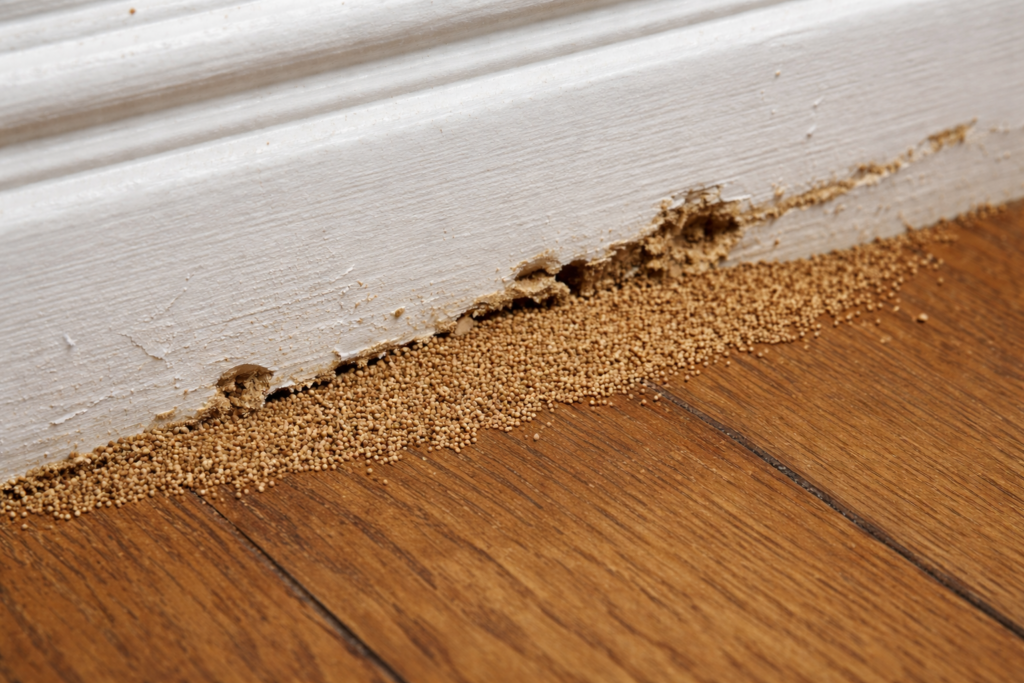
Termite damage is often mistaken for water damage because the symptoms look strikingly similar.
One of the most visible signs of a mature infestation is a "swarm." This usually happens in the warmer months after rain, when winged reproductive termites (alates) fly out of the colony to find mates and start new nests.
If you find winged insects in your home, it is critical to determine if they are flying ants or termites, as both swarm at similar times of the year.
How to Identify a Termite Swarmer:
Even if you miss the actual swarm, look for discarded wings on windowsills, near doors, or on the floor. Termites shed their wings immediately after finding a mate, so piles of transparent wings are a "smoking gun" that a colony is establishing itself nearby.
Ignoring a squeaky floor or a hollow-sounding wall can lead to financial devastation. Termite damage estimates range from $5 billion to $16 billion nationwide every year, with the vast majority of that cost going toward structural termite damage repairs rather than just pest control.
The danger of termites is that they are "silent destroyers." They can eat 24 hours a day, 7 days a week, without stopping. By the time you notice the floor sagging or the walls sounding hollow, the colony may have been active for years, compromising the structural beams that hold up your house.
Weak Points to Watch: During an inspection, it is important to check not just for termites, but for the conditions that attract them. "Conducive conditions" include:
If your floor bounces, squeaks, or feels uneven, do not assume it is just "old house charm." It could be the sound of your home’s structure giving way to a hidden infestation. Whether it is the muddy tunnels of subterranean termites or the sawdust-like piles of drywood termites, the evidence is there if you know where to look.
The most reliable way to confirm the cause of your home's structural issues is a professional termite inspection. A qualified expert can identify not only the presence of active termites but also the dry rot, water damage, and structural weaknesses they leave behind. Early detection is the only way to turn a potential structural disaster into a manageable repair.