Rat infestations cause more damage and health risk than most homeowners expect. Because rats are larger and more destructive than mice, they can chew structural materials, contaminate food, damage wiring, and spread disease quickly. Many infestations are first noticed through sounds in walls or ceilings, but noise is only one warning sign.
In Sacramento and across Northern California, rat activity tends to spike in late fall and winter as outdoor food sources dry up and rodents move indoors for warmth. We also see heavy roof rat pressure in neighborhoods with mature trees and dense landscaping, and Norway rat issues near waterways and older sewer infrastructure.
This complete Sacramento rat control guide explains how to identify rat activity, what rats sound like, where they hide, how they enter homes, how to remove them safely, and how to prevent future infestations.
Unusual noises in walls or ceilings are often the first sign of a rat problem. Because rats are much heavier than mice, their movement produces louder and more forceful sounds. Correctly identifying those sounds helps you determine whether you are dealing with rats, mice, or another animal.
Here is how to recognize typical rat noise patterns and what each sound usually means.
The most obvious difference between a mouse and a rat is weight. A mouse weighs less than an ounce, while an adult rat can weigh up to a pound. When a rat moves across your drywall or ceiling joists, it does not sound like a light scratch.
You will hear fast, heavy scurrying or running footsteps. It often sounds like a squirrel running inside the structure.
Because of their size, rats often stick to main support beams or pipes. You might hear the sound travel across the length of the room rather than staying in one corner.
Mice are generally restricted to scratching sounds because they lack the mass to create impact noises. Rats are different. They are agile jumpers and can be clumsy when navigating tight spaces like soffits or wall voids.
If you hear occasional "thumps" or "bumps" in the night, it is almost certainly a rat (or a larger animal like a raccoon or squirrel). This noise usually happens when they jump between joists or bump into obstacles in the dark.
All rodents need to chew to keep their teeth sharp, but rat teeth are much stronger than mouse teeth. They are capable of chewing through aluminum, wood, and even concrete.
Rat gnawing is loud and persistent. It sounds like a rough, grinding noise, similar to a saw cutting through wood.
If you hear this sound near plumbing or electrical areas, investigate immediately. Rats are notorious for chewing through PVC pipes and live wires, which can cause floods or fires.
Rats are nocturnal and follow a fairly predictable schedule. They tend to be cautious and will wait until the house is quiet to begin their work.
You are most likely to hear them shortly after sunset as they leave the nest to forage, and again just before sunrise as they return to sleep.
Unlike mice, which might feed intermittently throughout the night, rats often have distinct periods of high activity followed by long silences.
Noise alone is not enough to confirm a rat infestation. Physical evidence provides more reliable proof. Rats travel the same routes each night and leave behind visible signs along those paths. Because they are larger and produce more waste than mice, the clues are easier to spot.
Look for the following indicators to confirm rat activity.
Rat droppings can be one of the most reliable indicators of species. Unlike the tiny, rice-sized pellets left by mice, rat droppings are substantial.
Rats have poor eyesight and navigate by hugging walls and baseboards. Their fur is covered in dirt and natural oils which leave dark, greasy smudges known as "rub marks" or "smear marks" along their travel paths.
Unlike mice, which prefer to nest exclusively indoors, Norway Rats are natural excavators that often live in underground network systems.
Rats produce a significantly higher volume of waste than mice, leading to a much stronger smell. If you detect a heavy, musky scent that smells like ammonia, you likely have an active infestation.
Rats do not just burrow in the ground; they tunnel through attic insulation to create warm, secure nests.
While mice chew wires, rats shear through them. Their teeth are rated 5.5 on the Mohs hardness scale, harder than iron and copper.
Droppings are one of the fastest and most accurate ways to tell whether you have rats or mice. While both leave pellet shaped waste, the size, shape, and distribution are different enough to identify the species with a quick inspection.
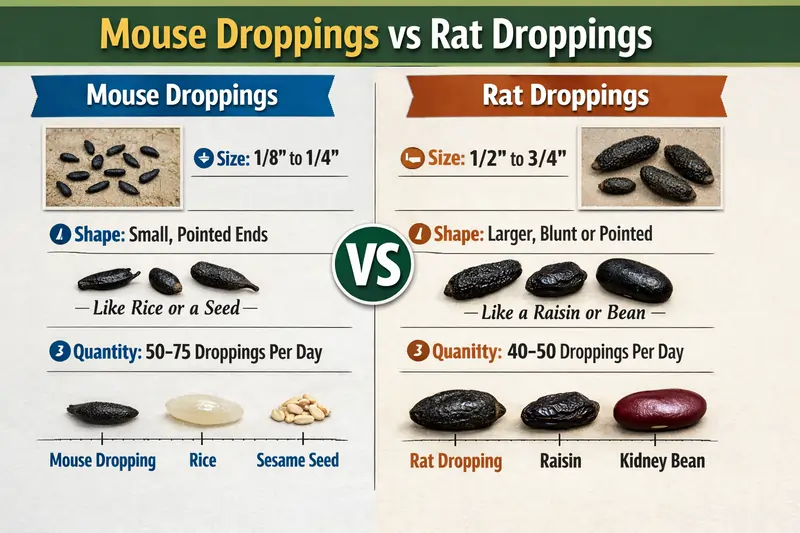
Use the guide below to compare what you are seeing.
House Mouse Droppings
Roof Rat Droppings
Norway Rat Droppings
The volume of waste can also provide clues about the size of the infestation.
Determining the age of the droppings helps you decide if the infestation is active or a remnant of a past problem.
Think Your May Have Mice Instead? How to Identify a Mouse in Your House
Rats are rarely seen in open living areas during the day. They choose hidden, protected spaces that provide warmth, darkness, and nearby travel routes. Nest location often depends on the species, with roof rats preferring elevated areas and Norway rats staying low or underground.
These are the most common indoor hiding locations.
This is the most common nesting area for roof rats. Because they are arboreal (tree-dwelling) by nature, they view your attic as a secure tree canopy. Check for nests made of shredded insulation in the corners of the attic or distinct tunnels burrowed through blown-in cellulose. You may also see grease marks along the top of ceiling joists.
For the Norway Rat, a crawl space is ideal. It mimics their natural habitat of riverbanks and underground burrows. Inspect the vapor barrier (the plastic sheet on the ground) for shredding. Look for burrow holes in the dirt near the foundation walls or kick-out piles of soil.
Walls act as the main travel points of your home. Rats use the space between studs to travel from the attic or crawl space to the kitchen without ever being seen. Listen for scratching or scurrying sounds at night. If you find a hole in the drywall near the floor (about 2-3 inches wide), it is likely an exit point from a wall void.
Garages are the most common entry point because the large door is frequently left open. Once inside, rats often decide to stay rather than move into the main house. Check the corners behind stored items and inspect the bottom of the rubber weather seal on the garage door for gnaw marks.
Norway Rats are powerful diggers and can undermine the structural integrity of your home by burrowing underneath concrete slabs. If you see a pile of fresh dirt next to the edge of a concrete patio or foundation slab, a rat has likely excavated a den underneath it.
Norway Rats (often called Sewer Rats) are actually excellent swimmers. They can hold their breath for up to three minutes and tread water for days. In rare cases, rats can emerge through the toilet bowl. More commonly, a break in a sewer line under the house allows rats to tunnel out of the pipe and into the soil under the home.
Rats are strong, flexible, and persistent. While they need a larger opening than mice, they can enlarge weak spots by chewing and clawing until they gain access. Most homes have multiple small vulnerabilities that are not obvious without a close exterior inspection.

Below are the most common entry routes we see in Sacramento and Northern California homes.
Norway Rats are burrowers that patrol the ground level of your home. They actively search for weaknesses where the foundation meets the ground or the siding.
Roof Rats (Black Rats) are agile climbers that prefer to enter homes from the top down. They often use power lines, fences, and overhanging tree limbs to access the roof.
Your home is designed to breathe, but those air intake and exhaust points are often guarded by flimsy plastic or wide-gauge mesh that rats can easily bypass.
Utility lines for water, gas, and electricity create holes in your home's envelope. Builders often cut these holes larger than necessary, leaving an "annular gap" around the pipe.
In many cases, the garage is the largest opening in your home and often the weakest link in your defense.
Unlike mice, rats are excellent swimmers. This allows them to exploit a terrifying entry point that other pests cannot: your plumbing.
Effective rat control starts with correct species identification. Roof rats and Norway rats behave differently, nest in different locations, and respond best to different control strategies. Treating them the same way often leads to failed removal.
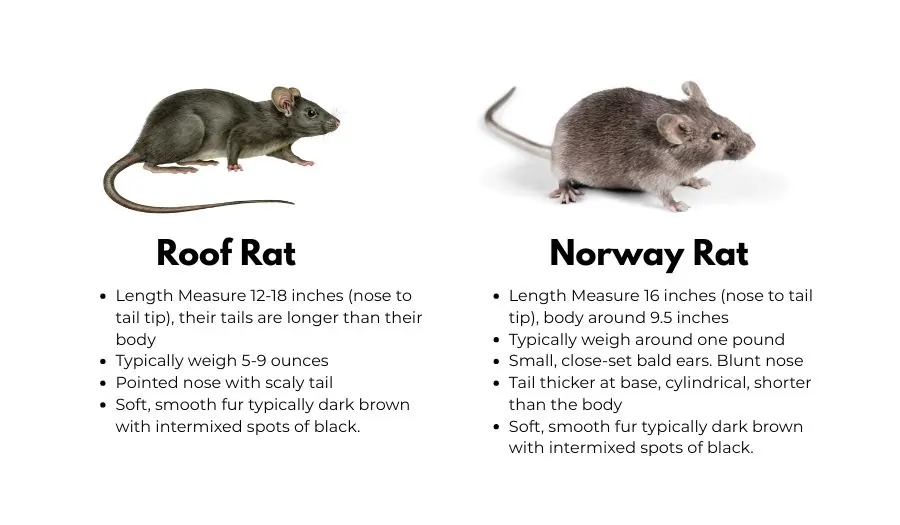
Here is how to tell which species you are dealing with.
This is usually the easiest way to rule one species out. Their names give away their preferred territories.
Because they occupy different "zones" of a house, their movement patterns differ significantly.
To catch them, you have to offer what they crave. Their nutritional needs dictate which bait will work best.
Understanding the "personality" of the rat helps you outsmart their instincts.
Rats settle where food, water, and shelter are predictable. Many infestations begin outdoors, then move inside once a safe entry point is found. Small property habits can significantly increase or decrease your risk.
These are the most common rat attractants around homes and buildings.
Household trash is a rat’s primary food source. They can smell rotting organic matter from great distances. Plastic bags offer no protection and loose lids make access easy. Use metal or heavy duty plastic bins with tight fitting, locking lids instead.
Dog and cat food is essentially a "superfood" for rats, packed with the proteins and fats they need to thrive. Leaving bowls outside overnight or storing bulk bags in the garage creates an all-you-can-eat buffet. Feed pets indoors or remove uneaten food immediately after mealtime. Store bulk food in galvanized steel or thick plastic containers.
A compost pile is a warm source of food, but improper composting turns it into a rat magnet. Adding meat, dairy, grease, or cooked grains to an open pile attracts omnivorous Norway Rats. Instead, stick to yard waste and vegetable scraps. If you compost food waste, use a tumbling composter that is elevated off the ground and fully sealed.
Rats, especially Roof Rats, are naturally drawn to sweet, high-calorie fruits. Fallen fruit left to rot on the ground provides an easy meal, while unpruned branches give rats a ladder to your roof. Therefore, pick fruit as soon as it ripens and rake up fallen produce daily. Install metal rat guards on tree trunks to prevent climbing.
While meant for birds, feeders are often the single biggest contributor to rodent populations in suburban areas. Rats do not usually climb the feeder; they feast on the mound of spilled seeds and hulls on the ground below. Due to this, use a catch-tray to prevent spillage or switch to "no-waste" seed varieties. If you have an active infestation, remove feeders entirely for two weeks.
Food draws them in, but safety makes them stay. Rats need cover to hide from predators like hawks and cats. Piles of lumber, old tires, rusted cars, or dense ivy provide the perfect nesting grounds. Try to keep firewood elevated at least 18 inches off the ground and clear away any debris that sits directly against your home’s foundation.
Rat infestations are not just a nuisance. They present real health and safety risks to people, pets, and structures. Contamination, parasites, disease exposure, and fire hazards are all well documented consequences of rodent activity.
These are the primary risks homeowners should understand.
Rats have no bladder control and dribble urine constantly as they walk to mark their territory. This means that every surface a rat touches, countertops, pantry shelves, and silverware, is likely contaminated with urine and microscopic fecal residue.
Rats act as a transport system for smaller, biting pests. When a rat enters your home, it brings its "passengers" with it.
The Centers for Disease Control and Prevention links rats to dozens of diseases. These pathogens are transmitted through direct contact, bites, or inhaling dust from dried droppings.

One of the most overlooked dangers of a rat infestation is the risk of fire. Rats have teeth that never stop growing, driving them to chew on hard materials to file them down.
Removing rats successfully requires more than placing random traps. Rats are cautious and learn quickly. A structured approach that combines exclusion, targeted trapping, and monitoring produces the most reliable results.

Use the following framework for safer and more effective rat removal.
Before you set a single trap, you must perform rodent exclusion to seal the exterior envelope of your home. If you leave entry points open, new rats will simply follow the pheromone trails of the old ones and replace them.
Inspect your foundation, roofline, and vents. Seal small gaps with steel wool and caulk, and cover larger openings with 1/4-inch hardware cloth. Rats can chew through expanding foam, so always use metal reinforcement.
Snap traps are among the most popular for homeowners because they are humane and allow you to verify the kill. Success relies entirely on placement.
Rats run along walls to feel safe. Place traps perpendicular to the baseboard with the trigger side touching the wall. Rats are suspicious of new objects (neophobic). For the best results, place the traps unset with bait for a few days. Once the rats are comfortable eating from them, set the triggers to catch them.
Rodenticides (poisons) often sound like an easy fix, but they come with a severe downside. Many people believe poison drives rats outside to die, but that usually is not what happens. Most retreat into walls or hidden voids instead.
Since a poisoned rat will often retreat to its nest to die, and nests are usually located in deep wall voids or under insulation, the carcass becomes unreachable. The resulting odor of decay can persist for weeks and may require cutting into drywall to remove the source.
Rats reproduce rapidly. A single pair can produce dozens of offspring in a year. If you are catching rats but still hearing scratching noises or seeing fresh droppings, the population may be growing faster than you can trap them.
If the infestation persists for more than two weeks despite your best efforts, it is time to contact professional rodent control. Experts have access to commercial-grade tracking tools and can identify hidden entry points that are easily missed by the untrained eye.
Small infestations can sometimes be handled with early action and correct trapping. Larger or established infestations usually require professional inspection and exclusion work. Delaying escalation often increases both damage and cost.
These signs indicate it is time to bring in professional rat control.
Ongoing Noise After Trapping
If you have set multiple traps and caught rats but still hear scratching, running, or gnawing in walls or ceilings, there is likely more than one nesting area. Professionals can locate hidden colonies and travel routes that are not obvious from inside the living space.
Repeat Droppings After Cleanup
Finding fresh droppings days after cleanup and trapping is a strong indicator of continued activity. This usually means active nesting nearby or new rats entering through unsealed gaps.
Attic or Crawl Space Activity
Rats in attics and crawl spaces are harder to eliminate because nests are hidden and access is limited. These areas often require protective equipment, detailed exclusion work, and targeted placement that most homeowners cannot safely perform.
Multiple Entry Points Around the Exterior
If your home has several gaps, vent failures, or foundation openings, trapping alone will not solve the problem. Professional exclusion work is needed to close all access routes so new rats cannot replace the ones removed.
Persistent Odor From Walls or Ceilings
A strong decomposition odor usually means a rat has died in a wall void or insulation cavity. Professionals have tools to narrow down the location and remove the odor at the source with minimal structural opening.
Failed DIY Attempts
If you have tried traps, sealing, and sanitation steps for two weeks or more without clear progress, the infestation is likely established. Continuing the same approach rarely produces a different result.
Large or Widespread Infestations
Heavy droppings, daytime sightings, or activity in multiple parts of the structure point to a large population. Large infestations require coordinated trapping, exclusion, and monitoring plans to eliminate fully.
Professional rat control combines inspection, exclusion, targeted removal, and follow up which can include full attic decontamination. That full process is what stops the cycle instead of just reducing numbers for a short time.
Long term rat prevention focuses on sealing entry points, removing attractants, and maintaining the structure so rodents cannot re enter. Prevention work is typically faster and less expensive than removal after an infestation is established.
Use the steps below to reduce your long term risk.
Rats can squeeze through openings about the size of a quarter and can chew through many common sealants. Walk the exterior of your home and inspect the foundation, siding joints, pipe entries, and utility penetrations.
Best practice is to pack gaps with copper mesh or steel wool first, then seal over it with exterior grade caulk or foam. The metal layer prevents rats from chewing back through the repair. Pay special attention to AC lines, gas pipes, and cable entry points.
Overhanging limbs act like bridges to your roof. Roof rats are strong climbers and often enter from above through soffits, vents, and fascia gaps.
Trim tree branches so there is at least a 3 foot clearance from the roof and upper walls. Also cut back dense shrubs along the foundation so rodents cannot hide while searching for entry points.
Trash is one of the strongest rat attractants around a home. Loose lids and damaged bins provide easy meals.
Use heavy duty cans with tight fitting or locking lids. Rinse bins regularly and keep them positioned away from exterior walls when possible. If rats are active in your area, consider bungee straps or weight bars on lids.
Many infestations start outside before moving indoors. Remove anything that provides consistent calories.
Focus on these common attractants:
Cleaning these up often reduces rodent pressure quickly.
Plastic vent covers and light screens are easily chewed. Rats frequently enter through dryer vents, attic vents, and crawl space vents.
Install 1/4 inch hardware cloth behind or over vulnerable vents. Secure it with screws, not glue alone. Make sure airflow is still adequate after reinforcement.
Exterior doors and garage doors commonly develop gaps as seals wear out.
Install quality door sweeps on all exterior doors. Check that no daylight shows underneath when the door is closed. Replace cracked garage door bottom seals and repair loose side weather stripping.
Even well maintained homes develop new gaps over time due to weather and settling. An annual rodent inspection helps catch small vulnerabilities before they turn into infestations.
A professional inspection can identify hidden entry points, early activity signs, and structural risk areas that most homeowners miss. Preventive inspections are one of the highest ROI steps in rodent control.
In our Sacramento and Northern California service area, most rat infestations we inspect involve more than one entry point and at least one hidden nesting zone in the attic or crawl space. A professional inspection maps entry routes, nesting sites, and travel paths so the problem can be fully sealed and removed.
During professional rat inspections in Sacramento homes, the most common hidden issues include:
No matter what kind of rodent problem you’re dealing with, you can count on Pinnacle Pest Control to provide top-notch rodent exclusion and extermination services. With decades of experience under our name, we have already helped hundreds of residents and business owners in Sacramento eliminate rodents in their property and keep them away for good.
The easiest way to tell is by sound, droppings, and damage. Rats are much larger than mice, so their movement sounds heavier and louder, often resembling running or thumping rather than light scratching. Rat droppings are larger, typically 1/2 to 3/4 inch long, while mouse droppings are closer to the size of rice grains. Rats also cause more severe damage, including torn insulation, chewed wood, and heavily gnawed wires. Read more at our mouse identification guide.
Yes. Rats pose serious health and safety risks. They contaminate surfaces with urine and droppings, carry diseases such as Salmonella and Leptospirosis, and often bring fleas and mites into the home. From a structural standpoint, rats frequently chew electrical wiring, which increases the risk of house fires, and they can damage insulation, ducting, and plumbing.
No. Rats do not leave voluntarily once they establish a nesting area and food source. If conditions remain favorable, the population will grow. Removing food sources alone rarely solves the problem if entry points and nesting sites remain accessible.
In Sacramento and surrounding areas, rat activity increases in late fall and winter as outdoor food sources decline and temperatures drop. Roof rats are especially active year round in neighborhoods with fruit trees and dense landscaping, while Norway rats are more common near waterways, storm drains, and older sewer systems.
Poison is generally not recommended for residential rat control. Poisoned rats often die inside walls, ceilings, or insulation, leading to strong odors that can last for weeks. Poison can also pose risks to pets, wildlife, and children. Trapping combined with exclusion is a safer and more controlled approach.
Small infestations may be resolved within one to two weeks if entry points are sealed and traps are placed correctly. Larger or established infestations can take longer and often require professional inspection, exclusion work, and follow up trapping to fully eliminate nesting zones and prevent reinfestation.
You we highly recommend you should call a professional if you continue hearing activity after trapping, find new droppings after cleanup, detect strong odors from walls or ceilings, or see signs of rats in multiple areas of the home. Homes with multiple entry points, attic infestations, or recurring problems typically require professional exclusion and inspection to fully resolve.



This will close in 20 seconds